Why Cheap TV Amplifiers Fail: Smoothing Caps, Hum and Noise
Cheap TV amplifiers fail because the parts around the RF stage are chosen to survive the warranty, not the installation. A low-grade electrolytic smoothing capacitor dries out under constant heat, its equivalent series resistance climbs, and the DC rail starts to ripple. That ripple modulates the amplifier, so a 50 or 100 Hz hum bar rolls through the picture and the noise floor rises. The red LED still lights, which is why installers keep blaming the aerial. Shielding is the second failure: an aluminium coating sprayed onto a plastic case has no continuous ground path, so it blocks nothing above a few hundred megahertz.
The failure chain starts at the power supply, not the RF stage
An amplifier is a power supply with an RF stage attached. In low-cost designs the supply is a transformerless dropper or a small switch-mode module, and the reservoir capacitor is the cheapest part that will pass a bench test on the day of assembly. Electrolytics lose capacitance and gain equivalent series resistance as they age, and the process accelerates with temperature. An amplifier mounted in a loft or on a mast in direct sun runs 15 to 25 degrees hotter than the ambient air, which is exactly the condition that shortens capacitor life.
When the reservoir capacitor can no longer hold the rail, the ripple rides on the supply that feeds the gain block. If the ripple is at twice mains frequency you get a hum bar drifting through the picture; if it reaches the AGC or bias network you get intermodulation products that look like extra noise on every channel. The amplifier is still amplifying. It is amplifying a dirty supply as well as the aerial signal.
- Picture symptom: one or two soft horizontal bars that slowly roll up or down the screen.
- Sound symptom: a buzz on the TV tuner that changes with picture brightness.
- Measurement: hum modulation at the output, visible on a spectrum analyser as sidebands spaced at mains frequency around the carrier.
- What the LED tells you: nothing. It monitors the presence of a rail, not its quality.
Why a sprayed plastic case cannot shield a TV signal
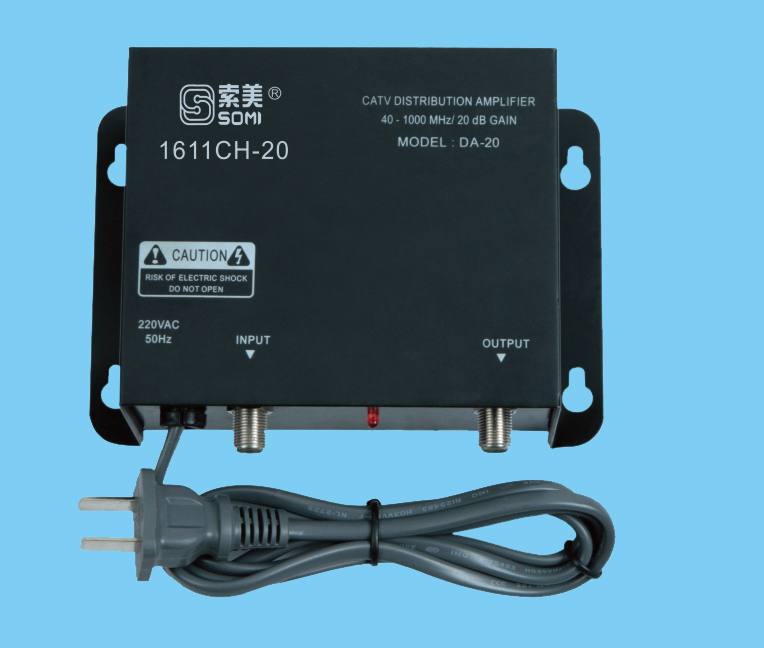
A common construction is a plastic housing with an aluminium layer deposited or sprayed on the inside. It looks like metal in the brochure. Electrically it is a thin, high-resistance film with seams, screw bosses and connector cut-outs where the coating is interrupted. Shielding effectiveness depends on a continuous, low-impedance ground path around the whole enclosure, and a sprayed film has neither the conductivity nor the seam bonding to provide one.
One installer on DIYnot described the result precisely: "Screened by aluminium sputtered on the plastic case. Cheap components, so the smoothing caps fail = hum = extra noise = signal becomes rubbish, despite the red light being on." That is a field diagnosis of two failures at once, the supply and the enclosure, and it is why the symptom is so often misread as a weak aerial.
Three numbers separate an amplifier from a toy
Gain alone is a marketing number. A 34 dB amplifier with a 12 dB noise figure is worse on a weak signal than a 26 dB amplifier with a 4 dB noise figure, because the second one does not bury the signal it is trying to lift. The same logic applies at the top end: an amplifier that clips at 110 dBuV cannot feed a four-way split without visible cross-modulation, no matter what the label promises.
| Parameter | What it actually tells you | What to accept |
|---|---|---|
| Noise figure | How much noise the first stage adds. In a mast amplifier this sets the system noise floor for the whole installation. | 7 dB or lower for an outdoor line amplifier |
| Output level | The maximum useful output before compression. Too low and you cannot drive a long passive split. | 127 dBuV or better at the rated gain |
| Gain flatness | How evenly the amplifier treats every channel in the band. A tilted response forces you to over-drive some channels. | Within about 1 dB across the working band |
How the 1632 series is built against these three failure modes
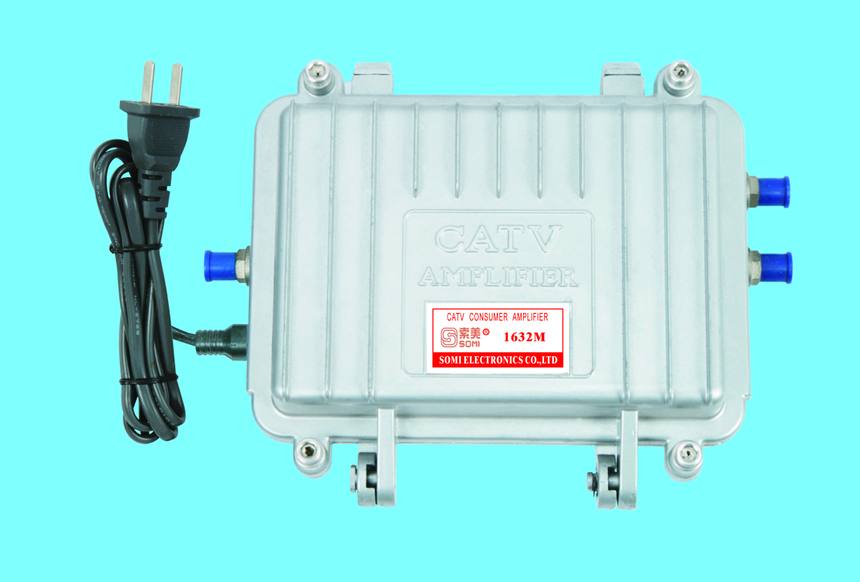
The 1632 outdoor line amplifier is specified against the failure modes above rather than against a headline gain figure. Gain is selectable at 26, 30 or 34 dB so the unit can be matched to the run instead of being run at maximum and padded down. Noise figure is published at 7 dB or better, output capability at 127 dBuV, and the electronics sit in a die-cast aluminium housing that provides a continuous ground plane bonded to the connector bodies.
The return path and powering arrangement matter as much as the RF floor. The 1632 passes AC 60 V through the trunk so a single power inserter can feed several amplifiers in a cascade, and the sub-band split is selectable at 42, 54, 65 or 85 MHz to match the operator's return-path plan. These are the details an installer needs at commissioning time, and they are the first things a low-cost alternative omits.
- Ask for the noise figure at the gain setting you will actually use, not at minimum gain.
- Confirm the output level is quoted at the rated gain with all channels loaded.
- Check that the housing is die-cast or extruded metal with bonded connector bodies.
- Confirm the sub-band split options match the return-path plan on site.
Incoming inspection checklist for amplifiers
A receiving inspection that takes fifteen minutes catches most of the failures described above before the goods reach an installation. It does not need a lab, only a supply, a signal source and a meter.
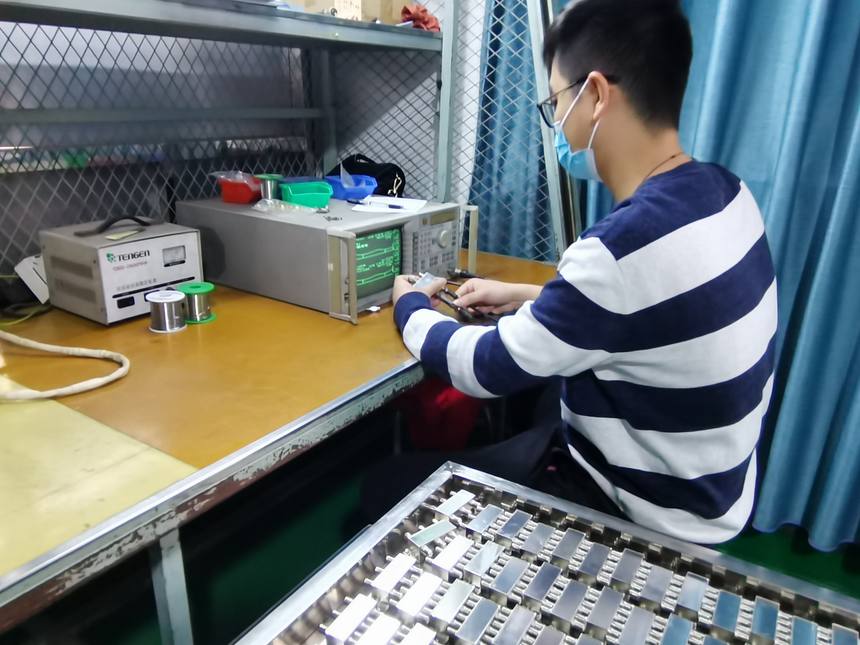
- Measure the supply rail ripple with the unit warm, after at least ten minutes under load.
- Check continuity between the F connector body and the housing; it should read a dead short.
- Feed a known level and confirm gain at each selectable step, then confirm the output does not compress at the rated level.
- Look for coating wear around screw holes and connector cut-outs on any painted or plated housing.
- Run the unit for an hour at rated load and re-check the hum modulation figure before accepting the batch.
What this means when you specify
The cheapest way to buy amplifiers is to compare gain per dollar. The cheapest way to own them is to compare noise figure, output level and enclosure construction, because those three determine how many units come back. If a supplier publishes only gain and frequency range, the missing numbers are the ones that fail in the field.
Need this checked against your own signal chain?
We publish noise figure, output level and construction details for every amplifier series, and we can quote against your topology rather than a single part number. Send the details through our inquiry form or reach the team on the contact page.
Request a quotation