TV Wall Sockets for European Installations: Types and Standards
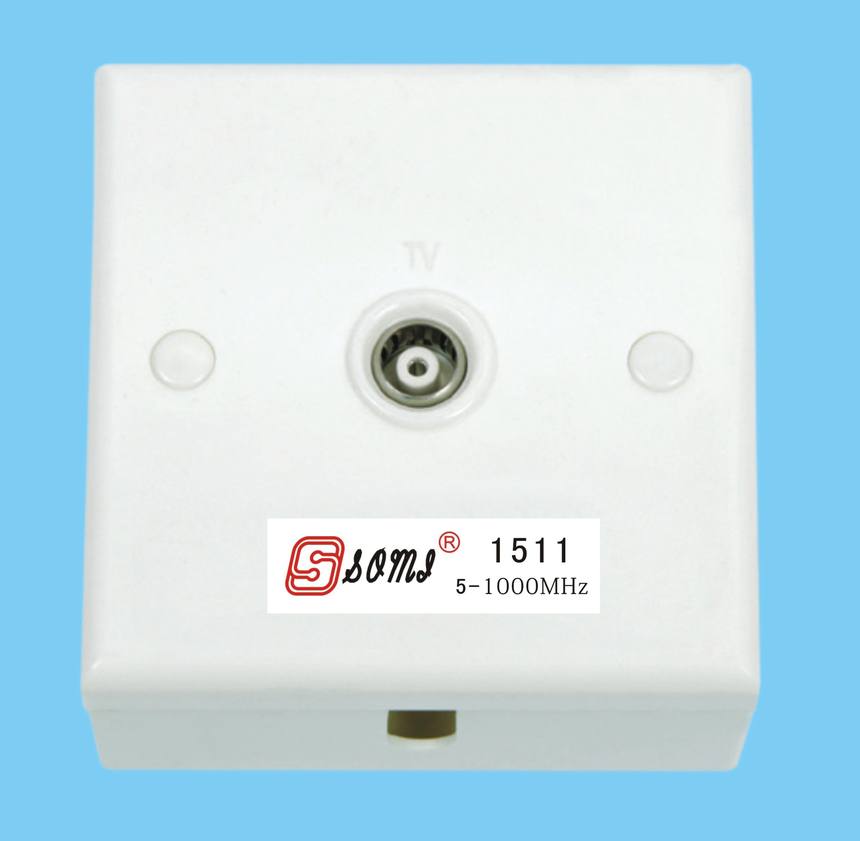
Choose the wall socket by what terminates at it, not by appearance. A general outlet such as the 1511 handles one TV feed with 0.4 dB insertion loss. A European-type outlet matches the faceplate and mounting standards used in EU markets. A deluxe outlet is a finish decision for hotels and high-end residential work. A data outlet combines TV and network termination, and a SAT socket splits satellite IF from terrestrial on separate ports. If satellite and terrestrial share one cable, the socket must be a diplexed type rather than a simple pass-through.
Why the outlet deserves a specification
Installers spend their attention on the aerial and the amplifier, then fit whatever wall plate the wholesaler has in stock. The plate is the last attenuation in the chain, and its loss is added to every other loss before it. A plate with 0.4 dB of insertion loss and a plate with 2 dB look identical on the wall and behave differently at the receiver, especially on the outlet at the end of the longest run.
There is a second reason to specify: the faceplate is the only part of the system the end customer touches. A plate that does not match the local mounting standard, or that cannot take the cable entry from the direction the wall allows, generates a complaint that has nothing to do with signal quality.
The five families and where each belongs
| Type | Typical use | What to confirm |
|---|---|---|
| General TV outlet (1511) | Single terrestrial feed in residential work | Insertion loss (0.4 dB IN-TV on 1511), shielding, cable entry direction |
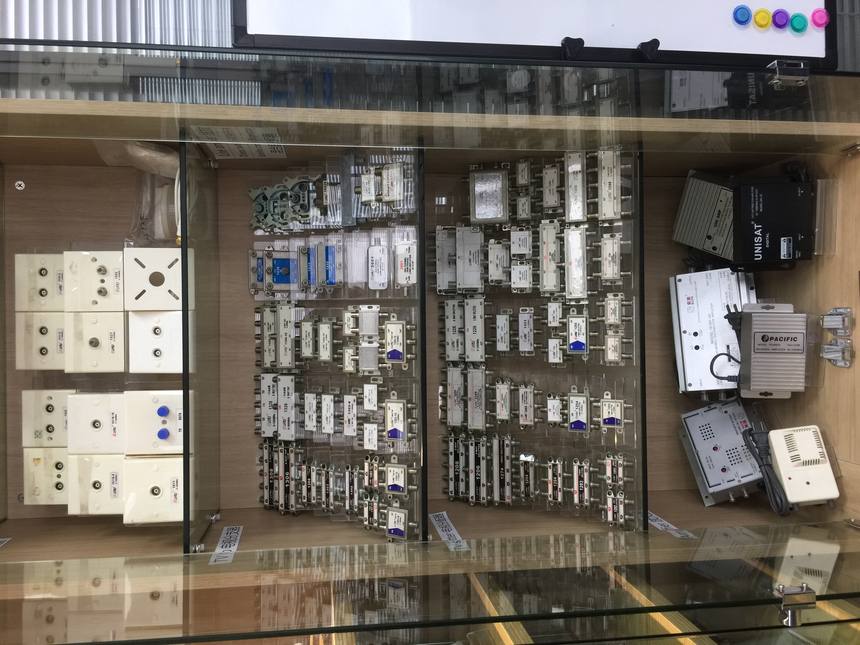
| European type (1222 series) | EU faceplate and mounting standards | Faceplate dimensions, screw spacing, standard compliance for the destination market |
| Deluxe (1202 series) | Hotels, high-end residential | Finish durability, plate material, matching accessories |
| Data outlet (1531 series) | TV plus network in one position | Separation between TV and data paths, crosstalk, keystone compatibility |
| SAT socket (2503HF) | Satellite IF and terrestrial in one plate | Diplexed structure, DC pass to the LNB, isolation between ports |
What 0.4 dB actually changes
On its own, 0.4 dB is negligible: it is a sixth of the loss of a metre of cheap coax. What matters is that it is published, because it makes the outlet a known quantity in a level budget instead of an assumption. An installation with eight outlets can be calculated, and the outlet at the end of the chain can be checked against the receiver's minimum input before the cable is pulled.
The same figure matters commercially. A distributor comparing two wall plates on price alone has no way to know whether the cheaper one costs 0.4 dB or 2 dB at the outlet, and the difference is paid for in service calls after the installation is signed off.
How a SAT socket splits the two services
A satellite wall socket is not a splitter in a box. It is a diplexer: the satellite IF path and the terrestrial path are separated by filters so that each port only carries its own band, and the satellite port passes DC so the receiver can power the LNB. Getting this wrong produces a receiver that works on one port and not the other, or an LNB that loses power when a second receiver is connected.
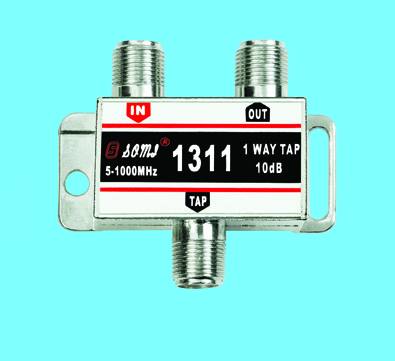
In new installations the cleaner arrangement is a feed per service, with the split performed at the head end and the socket providing separate ports. In retrofits where one cable reaches the room, the socket must carry both bands and the splitter upstream must be rated to 2400 MHz or higher.
Matching the outlet to the market
European installations tend to use flush-mounted boxes with a defined screw spacing and a plate depth set by the wall finish. Indonesian and wider Southeast Asian installations often use surface-mounted boxes, where cable entry direction and plate thickness matter more than screw spacing. A single plate design rarely serves both without an adapter, which is why the European type range and the general range are separate product lines rather than finishes of the same part.
The same logic applies to the satellite variants: a market that installs multiswitches expects a plate that passes DC and tone on the correct port, while a market that installs single-receiver systems expects the simplest possible pass-through. Both are correct for their market and wrong for the other.
Customising the faceplate without breaking the part
Private-label faceplates are a common request, and the constraints are worth stating up front. The logo area has to sit where the mould can carry it without creating a sink mark on the visible face. Colour changes require a separate batch, which affects MOQ. Printing on a textured surface wears faster than moulding the mark into the tool, and the choice between the two is a decision about the warranty rather than the appearance.
For buyers comparing quotations, the useful question is which of these changes affects the tooling and which only affects the batch. A colour change is a batch decision; a new logo position is a tooling decision; a new plate shape is a new part. Suppliers who answer that question clearly are usually the ones who can also hold a delivery date.
The outlet checklist
Five questions close most of the risk at the outlet, and all of them can be answered before an order is placed.
- What is the insertion loss on the TV path, and is it published?
- Does the plate match the mounting standard of the destination market?
- For satellite, is the socket diplexed, and which port passes DC?
- Is the shielding figure stated, and does the plate bond to the cable screen?
- For private label, which changes affect tooling and which affect the batch?
Need this checked against your own signal chain?
Send the destination market and the mounting standard and we will shortlist the plate families that fit, with insertion loss figures and MOQ per variant. Send the details through our inquiry form or reach the team on the contact page.
Request a quotation