LTE 700 Interference: Filter Before You Amplify
Yes, in most cases a filter is needed before the amplifier, not after it. A mast amplifier sees everything the aerial collects, and a nearby LTE or 5G downlink at 700 to 800 MHz can be tens of dB stronger than the TV multiplexes. The amplifier lifts both, then the strong signal drives the output stage into compression and generates intermodulation products that land inside the TV band. Filtering at the amplifier input removes the blocker before gain is applied, which is the only order that works.
Why the interference arrives at all
A wideband aerial cut for 470 to 790 MHz does not stop at 790 MHz. Its response rolls off gradually, so a base station transmitting at 800 MHz still couples tens of dB of signal into the downlead, and a masthead amplifier mounted next to the aerial sees that energy at its input. When the site is within a few hundred metres of a macro cell, the downlink can be comparable to or stronger than the wanted multiplexes.
The result is not usually a weak picture. It is a picture that breaks up when the cell is busy, because the interference is not constant: it follows traffic. That is why complaints cluster in the evening and why installers who test at midday conclude the installation is fine.
What overloading looks like on screen
An amplifier pushed into compression does not simply clip. It generates products at sums and differences of the interfering and wanted carriers, and those products fall both inside and outside the TV band. Inside the band they appear as a raised noise floor, mosaic artefacts and multiplexes that fail only on some receivers.
- One multiplex failing while others are clean: usually ingress at a specific frequency rather than overload.
- All multiplexes degrading together when the network is busy: classic front-end overload.
- A channel that works with the amplifier bypassed and fails with it in line: gain is being applied to a blocker.
- Signal level measured at the outlet that looks correct while the picture fails: level is not the problem, linearity is.
The order of devices is the whole argument
There are two ways to place a filter and only one of them works. Filtering after the amplifier removes the blocker from the output, but the amplifier has already been driven into non-linearity, and the intermodulation products it created sit inside the TV band where no filter can separate them from the wanted signal. Filtering before the amplifier keeps the gain stage linear, so the products are never generated.
The practical arrangement at a mast is: aerial, LTE filter, masthead amplifier, downlead. Where the amplifier is indoors, the filter still belongs at the amplifier input, and the cable between aerial and filter should be the shortest run available, because every metre of coax also picks up the interfering field.
Does an LTE filter cure a 5G problem?
Partly, and the answer depends on which band the operator uses. Filters designed for the 700 MHz digital dividend remove the 694 to 791 MHz downlink, which covers the lower 5G band in many European markets. Higher 5G bands at 3.4 to 3.8 GHz are far outside any TV aerial's passband and rarely couple into the downlead with enough strength to matter, unless the aerial is physically close to the antenna and the cable screening is poor.
Where both a 700 MHz and an 800 MHz service are present, a filter with a steeper skirt is needed, because the wanted multiplexes start at 470 MHz and the upper channels sit close to the blocker. This is a specification question, not a marketing one: ask for the stopband attenuation and the passband insertion loss, and check the transition width against the channel plan.
Using the sub-band split on a line amplifier
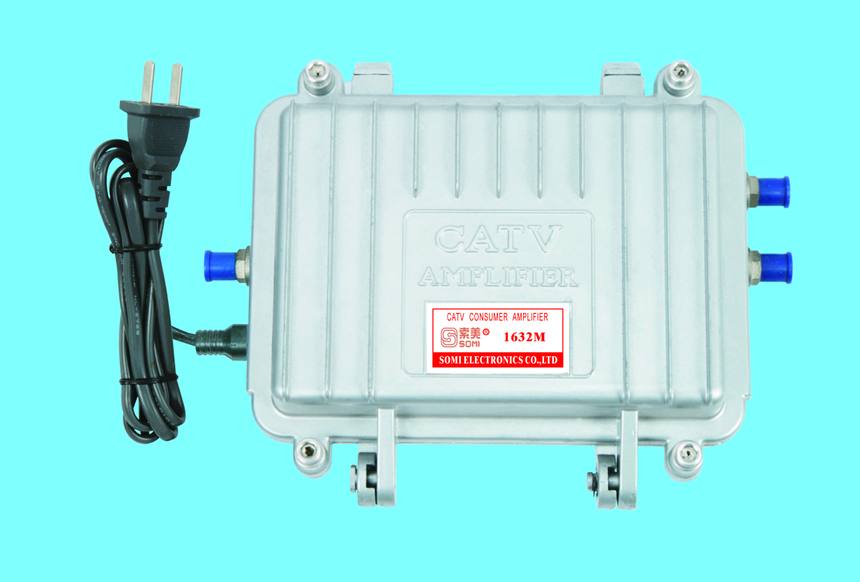
The 1632 outdoor line amplifier offers a selectable sub-band split at 42, 54, 65 or 85 MHz. That selection is usually discussed in the context of return-path planning, but it also affects how the amplifier treats low-frequency ingress. Choosing a split point above the noisiest part of the return band keeps that noise out of the forward path, which is the same principle as filtering before gain, applied inside the amplifier.
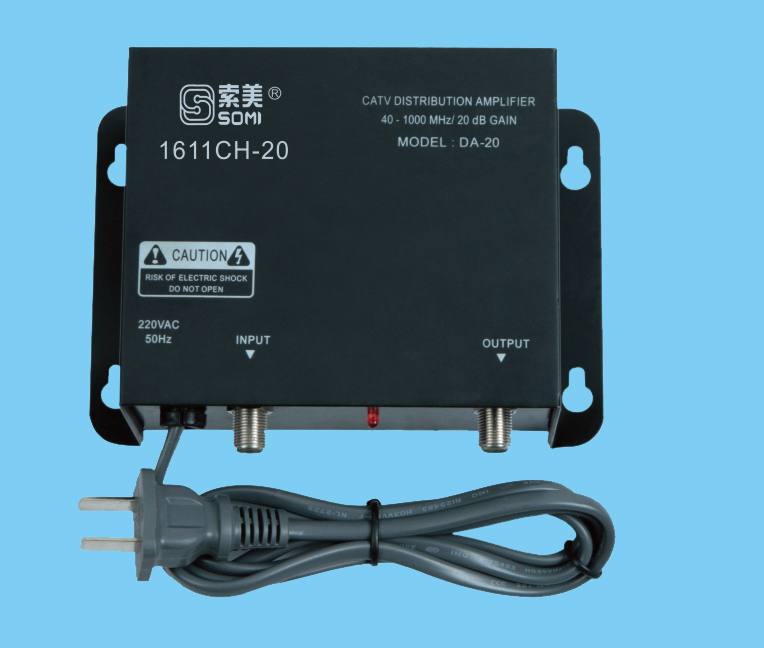
For installations where the blocker is strong enough that an external filter is unavoidable, the amplifier should still be the second device in the chain. The 1611 indoor amplifier at 40-1000 MHz and 20 dB gain is often used downstream of a filtered masthead, where its job is to recover the loss of a long downlead rather than to fight interference.
A four-step diagnosis that ends with an action
Field diagnosis works best as a sequence of eliminations, each of which produces evidence rather than an opinion. The steps below are ordered so that the cheapest test comes first.
- Measure the level at the aerial with the amplifier removed. If the multiplexes are already strong, the installation does not need gain.
- Reconnect the amplifier and measure at the outlet. Equal rise on all channels indicates linear operation; unequal rise points to a blocker.
- Insert a filter ahead of the amplifier and repeat. Improvement confirms out-of-band interference; no change moves the investigation to screening and connectors.
- If the problem persists, check the fly lead and wall outlet. A poorly screened lead near a window can couple more energy than the aerial collects.
What to specify when ordering
Specifying a filter is a matter of four numbers: passband, stopband, attenuation and insertion loss. A supplier who publishes all four, with a measurement method, has given you something you can reject a delivery against. A supplier who publishes only a centre frequency has given you a name for a product.
Need this checked against your own signal chain?
Send us the channel plan and the distance to the nearest base station, and we will suggest a filter and amplifier combination rather than a single part. Send the details through our inquiry form or reach the team on the contact page.
Request a quotation